Stepping Up Communication @ SPC
I've been banging the drum for better communication at SPC since 2004! To be fair, communications have improved significantly since then — we have a website, receive reports from both the Board and from Management, and get targeted emails about issues that affect us. However, just having these doesn't mean that communications are great... and frankly, in some area, they are not good enough. There are some major gaps, and even instances in which our Board seems to wield communications tools with the purpose of warding off true engagement.
- Online Meetings
- Other Meetings
- Board Reports & Updates
- Website (see separate article here)
- Proposed Solutions
Online Meetings
Our co-op performed very well during Covid — there were ample percautions, frequent updates, and, once we discovered Zoom, we even had meetings!
In many ways, Zoom is great — it is a relatively easy and cheap way to conduct meetings, and it avoids many messy aspects of meeting in person. However, our Board seems to have particularly embraced the significant drawback to Zoom meetings — they are one-sided. Through a moderated online meeting, our Board can convey the idea that they are unquestionnably on top of everything, that their answers are absolutely right. They can demonstrate that they are fully engaging with the community at the same time as they downplay dissent!
There are many ways in which people would engage in in-person meetings. They would state their points with stories or emotion. They would provide context to their questions. They would follow-up with questions, clarifications, or challenges. They would raise tangential issues. They would cheer or jeer comments made by presenters or questionners. In the sterile framework of a moderated Zoom meeting, none of this takes place.
Zoom's moderated format also serves the agenda of the presenter. People can't pose follow-up questions in real time, and their questions or follow-ups can be misinterpreted by the reader, or be disregarded entirely.
The bottom line is that, despite its great utility, Zoom also provides our Board with a hidden means of controlling the narrative. This was blatantly evident at the January meeting in which our Board "sold us" on their plans to immediatly undertake a $32 million renovation project. To hear the meeting, one would think it was a perfect, coherent, and well-supported plan that was to be launched in the coming weeks. But if this was a live meeting, it would have been accompanied by loud shouts, searing questions, and arguments! Fortunately the project was delayed, and this allowed time for the protests in our community to catch up with the plans for its implementation. In response to our community's outcry, our Board subsequently substantially reduced the scope of the project and has engaed a company to engage in community surveys about what we want to have done.
Quite simply, Zoom meetings can insulate our Board from hearing — or even considering — dissenting views. This is a disservice to all of us.
Other Meetings
Aside from the Annual Meeting proscribed by our Bylaws, meetings at SPC typically have one of two objectives — to roll out plans that have been made (such as large maintenance increases, or the recently quashed large-scale renovation of our Lobbies/Grounds), or to sell something for which they need Shareholder buy-in (such as the 2018 Air Rights sale). Never are Shareholders invited to significantly influence which plans are being advanced or their primary features.
To be fair, our Board is composed of unpaid volunteers who are doing their best, and are already working hard on our behalf! Polling our entire community on every decision would be impossible! But on the flip side, our Board wasn't elected to be subject-matter experts on everything! Quite simply, they are not the repository of all the good ideas our community has to offer, and, for the most part, don't have professional-level knowledge with regard to the the decisions they are making on our behalf.
There are countless examples of how community input is successfully collected in the context of all sorts of projects and communities — the example closest to home was the successful development of the SPURA properties into Essex Crossing! Community engagement is possible. Frankly, our Board just hasn't wanted to engage our community!
As of this writing, our Board has committed to engage a consulting company to survey our community with regard to our aspirations for our lobbies and grounds. I certainly hope it's an open-ended engagement that allows our Board to hear and incorporate some of the great input coming from our community!
Board Reports & Project Updates
Year after year, our Boards have boasted about how much communication they have conducted. That is why I was amazed to learn, during the January meeting about the proposed Lobbies & Grounds Renovation Project that our co-op had already spent $2.5 million over the past two years developing this project! I would think that a major initiative like this would have worked its way into the Boardroom Reports over the past two years!
Why on earth does our Board think that minimal communication is a good thing?
Proposed Solutions
Town Halls
We already have an Annual Meeting. I propose that we have quarterly meetings! In particular, I propose that we compliment our Annual Meeting with three Town Halls meetings. These don't have to be all-hands meetings in big spaces. They can touch on particular themes, but should also be fully open for participation.
Other Media
Several Candidates for our forthcoming election (Guido, Maria & Rachel) conducted an event on Hester Street on April 11. They affixed several posters to a fence, and invited people to write their ideas on post-it notes and affix them to the posters. My favorite is an aerial photo of our property with the headline "where do we need improvements?".
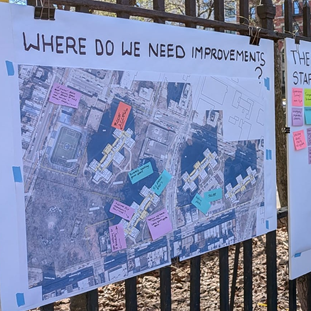
In all the years I have been here, never have I seen our Board ever produce such an open-ended question! It's not rocket science! And such open-ended questions would yield ideas, insights, participation, and buy-in! I wonder if our Board might engage in such exercises on a regular basis — perhaps in electronic form — so that Shareholder ideas could be collected and retained.
House Committee
Our community is huge and diverse. We have great skills, wisdom, and ideas in our community. Our Directors — while energized and optimistic — don't have the skills, bandwidth, or expertise to do it all. It only makes sense to establish a House Committee through which Shareholders can engage in our governance and committees. Furthermore, participation in such a committee would form a pipeline through which new leaders of our community can emerge.